

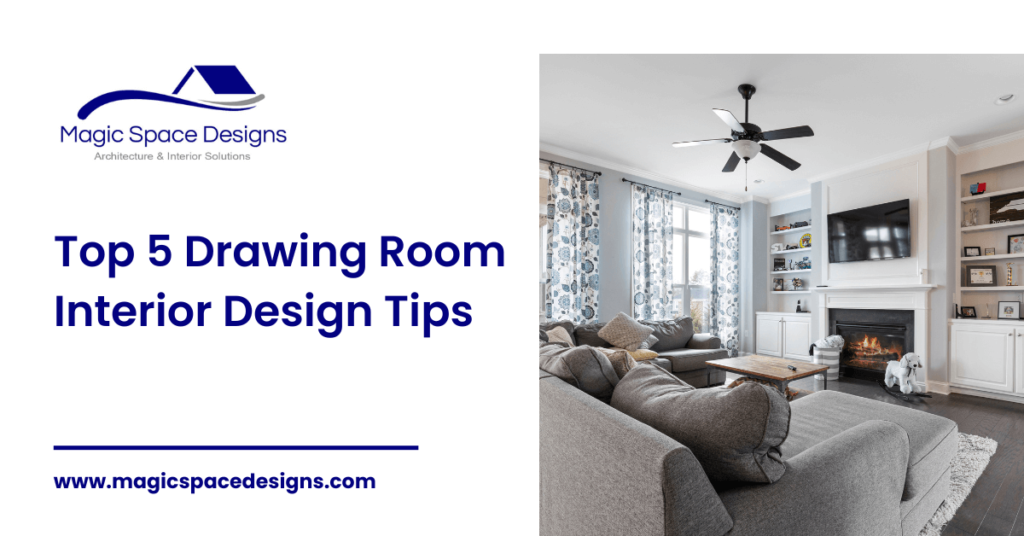
A great drawing room isn’t just “Instagrammable”—it’s the place where conversations flow, kids sprawl on the rug, and guests feel instantly at ease. Think of it like an orchestra: when layout, lighting, colour, furniture, and styling play in harmony, the whole room sings. When even one section is off, the space feels a little… awkward.
Below are five drawing room interior design tips I use in real homes. Each tip includes hands-on steps, practical measurements, and simple reasoning so you can apply it immediately—no design degree required.
1) Plan the Layout First: Flow Before Show
A beautiful sofa won’t save a room with a clumsy layout. Start with function and circulation—the invisible paths people take to move around furniture.
How to map your room like a pro
- Define the main purpose: Is your drawing room for hosting, family TV time, quiet reading, or all of the above? Prioritise zones accordingly.
- Create conversation groupings: Arrange seating so people face each other—not the TV. Two chairs angled toward a sofa often feel more inviting than one long sectional.
- Respect walking lanes: Leave clear paths so no one squeezes past knees or corners.
Practical spacing benchmarks
- Sofa ↔ coffee table: about 35–45 cm (14–18 in) for comfortable reach without knee bumps.
- Primary walkway: aim for 75–90 cm (30–36 in) so two people can pass with ease.
- Rug edge ↔ wall: 10–20 cm (4–8 in) of floor showing gives a finished frame without shrinking the room.
Analogy: Lay out your room like a city map. Sofas and chairs are “buildings”; walkways are “roads.” If roads are blocked, traffic (aka people) jams.
Mini case: A family with a long, narrow drawing room kept the sofa against the long wall and wondered why it felt like a hallway. We floated the sofa 30 cm (12 in) off the wall, added two slender armchairs opposite, and used a narrow (but long) coffee table. The room suddenly felt balanced—and conversation-friendly.
2) Layer Your Lighting: Atmosphere You Can Switch On
Lighting is the mood remote for your drawing room. One overhead “big light” can make a space feel flat and unforgiving. Instead, combine ambient, task, and accent lighting so you can tune brightness to the moment.
The three layers (keep all!)
- Ambient: Soft, general light (ceiling fixtures, recessed lights) for everyday use.
- Task: Focused light where you do things (floor or table lamps near reading chairs, picture lights over consoles).
- Accent: Directional light to highlight art, plants, stone, or textured walls—adds depth and drama.
Practical tips that always pay off
- Use two to three lamp types (e.g., a floor lamp + two table lamps) to avoid “spotlight stress.”
- Dimmer switches are tiny investments with outsized impact—dinner party? dim. Reading time? brighten.
- Warm white (around 2700–3000K) is cosy and flattering; reserve cooler temperatures for task-heavy corners if you prefer.
Pro move: Angle a floor lamp so light grazes a textured wall—instant boutique-hotel vibes.
3) Curate a Cohesive Colour & Material Palette (Start with the Big Five)
The room’s palette isn’t just paint; it’s walls, large furniture, rug, curtains, and wood/metal finishes. Choose these five together and the rest of the room almost styles itself.
The “Big Five” selection order
- Rug first (if using): It’s the largest pattern block and sets the tone.
- Sofa fabric: Neutral and durable wins for longevity.
- Curtains: Either blend with the wall for height or contrast with purpose.
- Paint: Choose after your textiles so you can match undertones accurately.
- Wood/metal finishes: Keep to two wood tones max and one dominant metal (e.g., brushed brass + black accents).
Light matters (and why some beiges look pink)
- Paint colours shift with daylight direction. North-facing rooms may cool colours; south-facing can warm them. Always test swatches on two walls and check morning, afternoon, and evening.
- If your room is small or dim, favour lighter mid-tones and matte/satin finishes to minimise glare while hiding wall imperfections.
Real-life example:
A client loved a deep teal accent wall from Pinterest. In their low-light drawing room, it turned murky. We lightened the teal by two shades and added a cream rug—suddenly the colour looked rich, not heavy.
4) Get Furniture Size & Ergonomics Right (Comfort = Luxury)
Even high-end pieces feel cheap if they don’t fit you or the room. Size, seat depth, and proportions are where real comfort lives.
Sizing that saves you from returns
- Sofa seat height: 40–46 cm (16–18 in) feels comfortable for most adults.
- Seat depth: 50–56 cm (20–22 in) supports lounging without swallowing shorter guests; add lumbar pillows to fine-tune.
- Coffee table length: roughly two-thirds the length of your sofa; height close to sofa seat height.
- Rug sizing: front legs of all seating pieces on the rug—this visually ties the zone together.
- Media distance (if you watch TV here): the diagonal of your TV × 1.5–2.5 ≈ viewing distance (e.g., 55″ TV → ~2–3.5 m / 6.5–11.5 ft).
Materials that live well
- Performance fabrics (tight weaves, stain-resistant finishes) for sofas and chairs in high-use rooms.
- Rounded corners on coffee tables = fewer bruises for kids and shins alike.
- Mix one standout silhouette (sculptural chair, arched floor lamp) with quieter staples to keep visual noise down.
Quick check: Can three guests set down a drink without playing coaster musical chairs? If not, add a side table.
5) Style with Intention: Personality, Storage, and the “Edit Pass”
Styling turns a good room into your room—but it’s also where clutter creeps in. Use a simple framework: anchor pieces, supporting layers, and empty space.
Build the look (without overdoing it)
- Anchor pieces: A statement art piece, large mirror, or striking console sets direction.
- Supporting layers: Books, plants, textured throws, and sculptural objects in varied heights.
- Negative space: Leave some surfaces partially empty so the eye can rest—visual breathing room is luxury.
Sneaky-smart storage
- Closed storage (media units, credenzas) hides remotes, chargers, board games.
- Baskets near seating corral throws and magazines—functional and tactile.
- Ottomans with lids double as footrests and toy bins.
The “edit pass” ritual
Stand in the doorway and snap two photos on your phone. Everything that looks fussy in the photo probably is. Remove one item per surface, then step back. Most rooms improve instantly.
Quick Checklist: Top 5 Drawing Room Interior Design Tips
- Layout first: clear walkways (75–90 cm), conversation-friendly seating, coffee table reach 35–45 cm.
- Layer lighting: ambient + task + accent; use warm dimmable sources.
- Cohesive palette: decide the Big Five (rug, sofa, curtains, paint, finishes) together.
- Right-sized furniture: ergonomic heights/depths; rug large enough to unite seating.
- Intentional styling: anchor piece + layered objects + negative space; add hidden storage.
If you are looking for a top interior designer in ahmedabad that can help you with your drawing room, Magic Space Designs is a perfect choice. With years of experience and a team of talented professionals, we can create a space that perfectly reflects your personality and style. Contact us today to learn more about our services or to get started on your project!
FAQs About Interior Design For Drawing Room
What’s the most important drawing room interior design tip if I’m on a budget?
Nail the layout and invest in a correctly sized rug. Together they make even inexpensive furniture feel intentional.
How many colours should I use?
Start with one dominant neutral, one supporting colour, and one accent. Let patterns (rugs, cushions) carry extra hues subtly.
Can I mix metals and woods?
Yes—keep it to one main metal + one accent (e.g., brass with black), and no more than two wood tones so it reads cohesive.
Is an accent wall still in style?
It can be, when it emphasises architecture (alcove, fireplace) or balances the room’s weight. If it feels random, skip it.
How do I make a small drawing room look bigger?
Use leggy furniture (so light flows under), larger but fewer pieces (not many small ones), and a generously sized rug to unify the seating zone.